
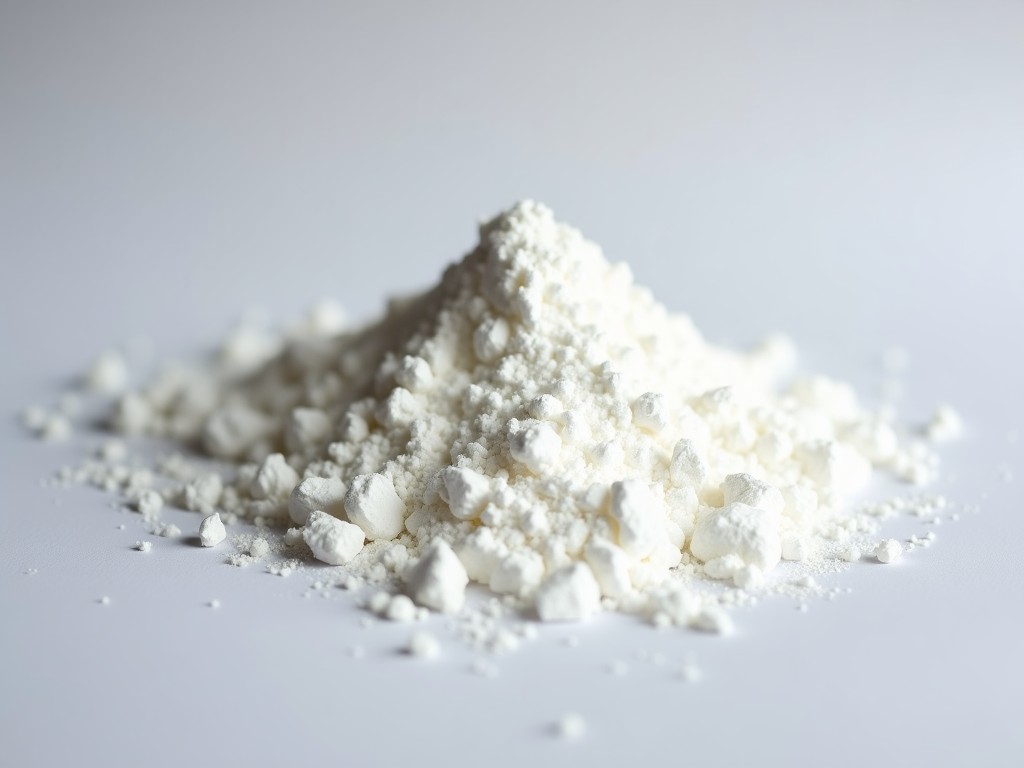
B2B High Quality Calcium Carbonate Powder
B2B Calcium Carbonate Powder
Calcium carbonate (CaCO₃) is a naturally occurring mineral widely used as a functional filler in industrial formulations. Its performance depends on particle size distribution, whiteness, and surface chemistry, which are engineered to meet specific end‑use requirements.
Key Technical Characteristics
As shown in the specification table, the median particle size (D50) falls within the 1.5–3.0 µm range with a top cut below 10 µm, which promotes uniform dispersion and low abrasion on extrusion screws.
The whiteness value exceeding 95 % ISO brightness, listed in the table, ensures high opacity without altering the base color of coatings or plastics.
The specific gravity of 2.71 g/cm³ results in a bulk density between 0.5 and 0.7 g/cm³, as indicated in the table, affecting the weight loading and handling of the compound.
Oil absorption values between 15 and 20 g/100g (see table) reflect moderate resin demand, allowing formulators to adjust plasticizer levels accordingly.
A neutral pH around 8.5–9.5 and moisture content under 0.2 % (table) help maintain chemical stability during storage and processing.
| Parameter | Typical Range | Test Method |
|---|---|---|
| Median particle size (D50) | 1.5 – 3.0 µm | Laser diffraction (ISO 13320) |
| Top cut (D98) | <10 µm | Laser diffraction |
| Whiteness (ISO brightness) | >95 % | ISO 2470 |
| Specific gravity | 2.71 g/cm³ | Pycnometry |
| Bulk density | 0.5 – 0.7 g/cm³ | ASTM D1895 |
| Oil absorption | 15 – 20 g/100g | ASTM D281 |
| Moisture content | <0.2 % | Karl Fischer titration |
Manufacturing Considerations
Two primary routes produce calcium carbonate powder for B2B supply: ground calcium carbonate (GCC) obtained by milling limestone, and precipitated calcium carbonate (PCC) formed via carbonation of calcium hydroxide.
GCC tends to exhibit a broader particle size distribution and higher aspect ratio, which can improve reinforcement in rigid PVC but may require higher dispersion energy.
PCC offers a more narrow size distribution, higher whiteness, and the ability to engineer crystal morphology (e.g., scalenohedral) for specific rheology in sealants.
Surface treatment options such as stearic acid coating are available to reduce oil absorption and improve compatibility with polar polymers.
Applications and Performance Benefits
In thermoplastic polyolefins, calcium carbonate acts as a stiffness modifier; the filler’s modulus (~70 GPa) raises the composite’s flexural modulus proportionally to loading level while maintaining impact strength when particle size stays below 2 µm.
For PVC cable compounds, the low oil absorption of coated grades reduces plasticizer migration, enhancing long‑term electrical insulation properties.
In paper coating, the high whiteness and fine particle size provide opacity and smoothness, allowing lower titanium dioxide usage and cost savings.
Water‑based paints benefit from the neutral pH and low moisture, which prevent corrosion of metal pigments and ensure stable viscosity during storage.
Rubber compounds use calcium carbonate as an extender that improves tensile strength at low loadings and reduces compound cost without significantly altering cure characteristics.
- Polyolefins: 10–30 wt % for stiffness and cost reduction.
- PVC cables: 5–15 wt % with stearic acid coating to control oil absorption.
- Paper coating: 15–25 wt % to achieve ISO brightness >90 %.
- Water‑based paints: 5–20 wt % as extender and settling inhibitor.
- Rubber: 10–40 wt % to enhance modulus and reduce compound cost.
Quality Control and Testing
Each batch undergoes laser diffraction analysis to verify D50, D97, and span, ensuring conformity to the agreed particle size specification.
Whiteness is measured spectrophotometrically under ISO 2470 conditions, with acceptance criteria typically set at >95 % brightness.
Moisture content is determined by Karl Fischer titration, and oil absorption is assessed via the ASTM D281 method to confirm surface treatment effectiveness.
A certificate of analysis (CoA) accompanies every shipment, reporting the actual values for each parameter and the test method used.
Packaging and Logistics
Standard packaging consists of 25 kg multi‑wall paper bags with an inner polyethylene liner, providing moisture barrier and easy handling on palletizers.
For bulk shipments, the product can be supplied in 1 tonne flexible intermediate bulk containers (FIBCs) or pneumatic tanker trucks, with nitrogen purging available to maintain low moisture during transit.
All packaging is labeled with batch number, production date, and safety information compliant with GHS regulations.
Customization Options
Particle size can be tailored through milling classification or precipitation control, allowing D50 values from 0.8 µm for ultra‑fine coatings to 5 µm for high‑loading filler applications.
Surface treatments include stearic acid, silane, or acrylic copolymers, each modifying oil absorption and polymer compatibility to suit specific resin systems.
Moisture content can be reduced to <0.05 % via additional drying steps for hygroscopic processes such as moisture‑sensitive epoxy resins.
Custom packaging sizes (e.g., 5 kg bags, 500 kg super sacks) are available upon request to match client logistics.
To discuss your specific requirements or request a sample, please contact our technical team.
Request a Quotation