
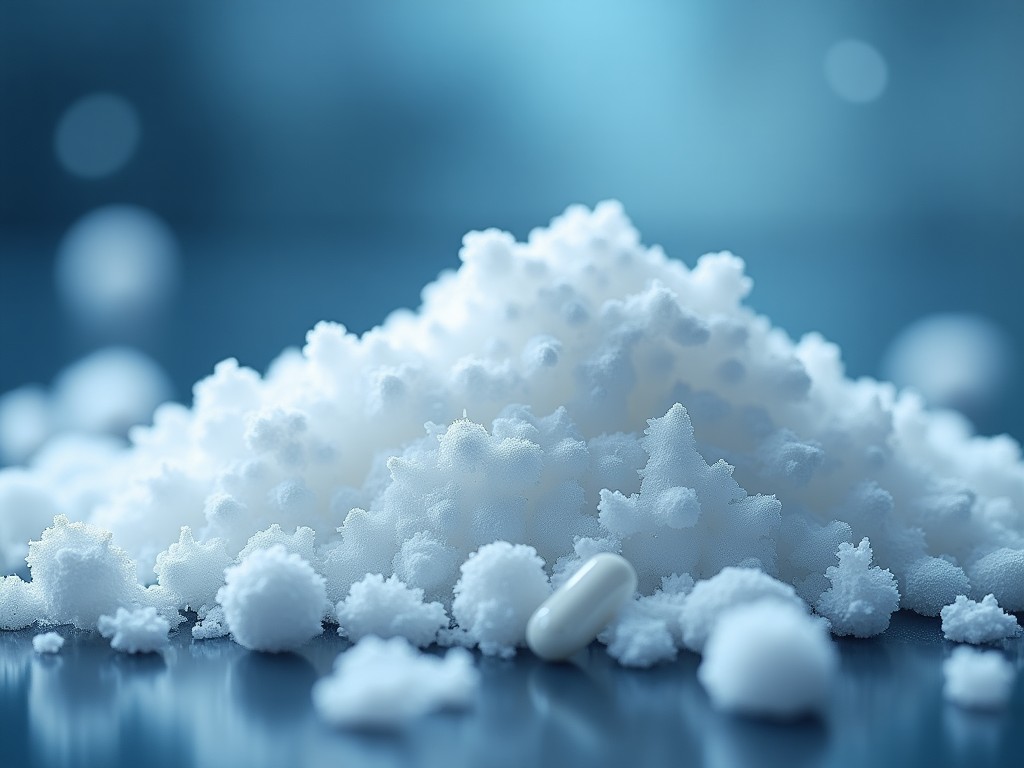
Colloidal Silicon Dioxide Pharmaceutical Use
Colloidal Silicon Dioxide for Pharmaceutical Use
Colloidal silicon dioxide (SiO₂), produced by flame hydrolysis of silicon tetrachloride, consists of sub‑micron amorphous particles that aggregate into loosely bound agglomerates. Its primary technical role in drug‑product manufacturing is to modify powder flow characteristics and to adsorb moisture or active ingredients.
Key Technical Properties
Typical values depend on the specific grade and production conditions; the following table lists common ranges for pharmaceutical‑grade colloidal silicon dioxide.
| Property | Typical Range | Test Method (Reference) |
|---|---|---|
| Primary particle size (nm) | 5 – 50 | TEM / BET |
| Specific surface area (m²/g) | 100 – 400 | BET nitrogen adsorption |
| Loss on drying (% w/w) | ≤ 1.0 | USP <731> |
| pH (5% w/v dispersion) | 3.5 – 5.0 | USP <791> |
| Bulk density (g/L) | 30 – 80 | ASTM B329 |
Pharmaceutical Applications and Functional Rationale
In solid‑dosage manufacturing, colloidal silicon dioxide is added at low concentrations (typically 0.1 %–2.0 % w/w) to improve flow properties of blends that contain cohesive active pharmaceutical ingredients (APIs) or excipients such as lactose, microcrystalline cellulose, or starch.
- Glidant: reduces inter‑particle friction, leading to higher hopper flow rates and more uniform die filling.
- Anti‑caking agent: prevents agglomeration during storage, especially under humid conditions.
- Adsorbent: can trap moisture or volatile oils, improving chemical stability of hygroscopic APIs.
- Disintegration aid (in some formulations): creates micro‑channels that facilitate water penetration upon tablet immersion.
Manufacturing and Process Considerations
Because the particles are extremely light and prone to aerosolization, handling requires closed‑system transfer or local exhaust ventilation to maintain occupational exposure limits (OEL) typically set at 0.1 mg/m³ respirable silica.
Incorporation is usually performed via dry blending in a V‑cone, double‑cone, or tumble blender for 5–15 minutes; over‑blending can lead to excessive de‑agglomeration and potential changes in surface chemistry.
For aseptic products, colloidal silicon dioxide can be sterilized by dry heat (e.g., 160 °C for 2 h) or gamma irradiation without significant loss of surface area, provided the grade is specified as low‑endotoxin.
Quality Standards and Regulatory Compliance
Pharmaceutical‑grade colloidal silicon dioxide must meet the monographs of USP
| Parameter | Limit (Typical) | Reference |
|---|---|---|
| Heavy metals (as Pb) | ≤ 10 ppm | USP <231> |
| Loss on ignition (% w/w) | ≤ 2.0 | USP <731> |
| Microbial aerobic count (CFU/g) | ≤ 10³ | USP <61> |
| Endotoxin (EU/g) | ≤ 0.5 (low‑endotoxin grade) | USP <85> |
Handling, Storage, and Safety
Store in a dry, temperature‑controlled environment (15 °C–25 °C) with relative humidity below 50 % to prevent moisture uptake that could alter flow properties.
Keep containers tightly sealed; use antistatic‑compatible liners if static discharge is a concern in high‑speed blending operations.
Refer to the Safety Data Sheet (SDS) for inhalation and skin‑contact precautions; engineering controls such as local exhaust ventilation are recommended during transfer.
Frequently Asked Questions
- Can the particle size distribution be customized?
- Yes. Grades are available with median primary particle sizes ranging from 10 nm to 30 nm, selected based on desired surface area and flow‑enhancement efficiency.
- What information is required for a quotation?
- Required details include target dosage form, intended concentration (% w/w), required regulatory grade (USP/EP/JP), packaging size, and any special handling constraints (e.g., low‑endotoxin, sterile‑grade).
- Which packaging options are available for bulk pharmaceutical grades?
- Standard options are multi‑layer polyethylene bags (25 kg) placed inside fiber drums, or rigid intermediate bulk containers (IBCs) with antistatic liners for larger volumes.
- How is quality verified for each lot?
- Each lot undergoes laser diffraction for particle size, BET for surface area, loss on drying, pH, heavy‑metal testing, and microbial limits; a certificate of analysis (CoA) is provided.
Request Technical Documentation or Sample
To obtain a certificate of analysis, safety data sheet, or to arrange a sample evaluation, please contact our technical support team.
Contact Technical Support