
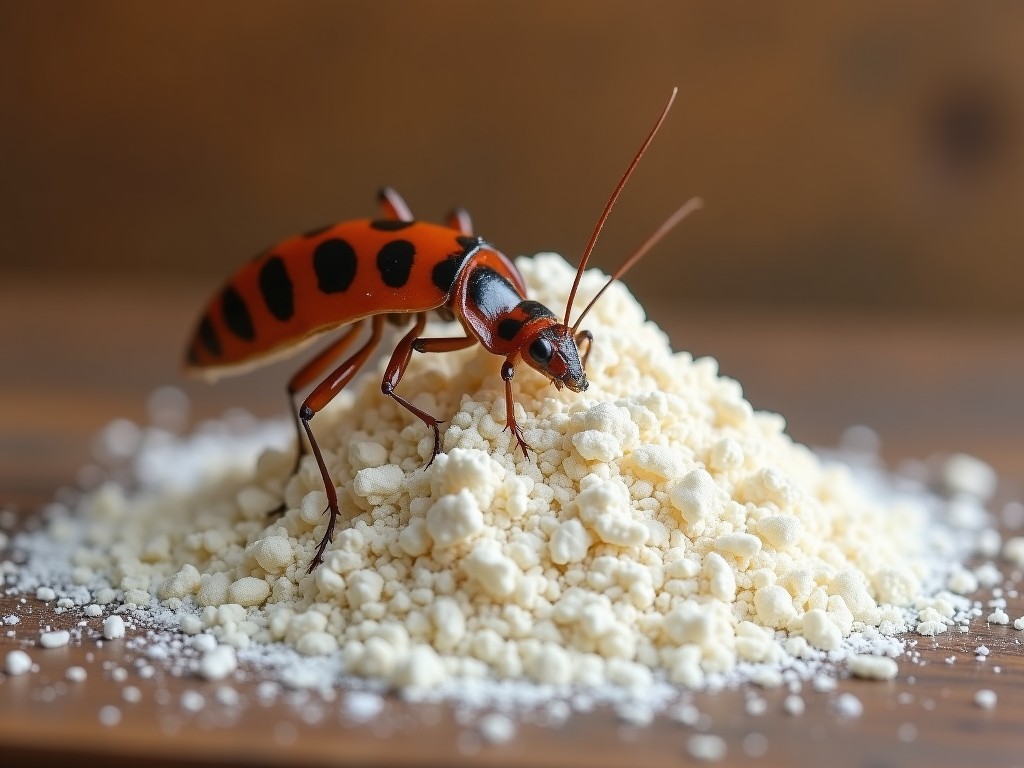
Diatomaceous Earth For German Roaches In House
Diatomaceous Earth for German Cockroach Control in Residential & Commercial Buildings
German cockroaches (Blattella germanica) account for the majority of indoor infestations reported to pest management operators across European and North American metro areas. Unlike outdoor species, they nest in warm, humid micro-environments—wall voids, appliance gaps, kitchen cabinet seams—and reproduce at a rate of 28 to 30 offspring per generation cycle. Chemical insecticide programs face escalating resistance pressures; diatomaceous earth, a silica-based mechanical desiccant, operates on a fundamentally different killing mechanism that no resistant phenotype has yet overcome.
This page is written for procurement managers at integrated pest management (IPM) firms, facility managers specifying building-maintenance protocols, and distributors sourcing technical-grade diatomaceous earth in bulk. It covers the engineering basis of efficacy, grade selection, particle-size requirements, application parameters, and B2B sourcing logistics.
Mechanism of Action: Why Silica Frustules Kill a Cockroach
The active fraction in pest-control-grade diatomaceous earth consists of fossilized diatom frustules—microscopic silica shells produced by Bacillariophyceae over 175 million years. When dried under controlled conditions, these frustules retain a sharp-edged, porous geometry with surface area in the range of 40–80 m²/g. The killing process is purely mechanical: as a German cockroach traverses a dusted surface, the diatomite abrades the waxy epicuticle layer. The resulting micro-perforations allow internal moisture to escape through the compromised cuticle. Without functioning spiracles and a sealed exoskeleton, the insect desiccates within 24 to 72 hours.
This mechanism matters for procurement decisions for three reasons:
- No metabolic target means no selection pressure for resistance. A population that survives a chemical rotation program will not develop tolerance to silica contact.
- No toxicity to mammals, aquatic organisms, or beneficial arthropods above the arthropod class. Food-grade diatomite carries an FDA No. 171.874 listing; technical-grade is regulated under EU Regulation 1107/2009 for plant-protection use but is not classified as a biocide for invertebrate control in residential settings.
- Shelf life is indefinite under dry storage. Unlike pyrethroid or organophosphate formulations that degrade thermally, diatomite retains its geometric integrity for years if kept below 70 % relative humidity.
The one operational limitation: diatomite loses efficacy when ambient humidity exceeds roughly 75 % RH for sustained periods, because water bridges the frustule gaps and restores exosurface sealing. In German climate zones where winter indoor humidity can reach 60–70 %, this is a manageable parameter; in tropical warehouse environments it must be factored into application frequency.
Grade Selection: Food-Grade, Technical-Grade, and Pool-Grade Diatomite
Not all diatomaceous earth on the B2B market is interchangeable. The source deposit, heat-treatment step, and residual crystalline-silica content determine which grade is legally permissible and which performs best in a residential IPM program.
| Parameter | Food-Grade Diatomite | Technical-Grade Diatomite | Pool-Grade (Low-Temp) |
|---|---|---|---|
| Crystalline-silica content | < 0.2 % (heat-treated to eliminate quartz) | Typically 1–3 %; acceptable for industrial pest control, not for food-contact surfaces | < 0.1 %; low-temperature processing, minimal friability for filtration |
| Particle size (D₅₀) | 20–40 µm | 30–60 µm | 40–80 µm |
| Suitable for residential German cockroach IPM | Yes – safest option around food-prep zones, child access points | Yes – appropriate for commercial kitchens, behind-appliance voids, structural cracks | Limited – coarser particles reduce contact abrasion on small-bodied B. germanica |
| Typical bulk density | 0.20–0.30 g/cm³ | 0.25–0.35 g/cm³ | 0.30–0.40 g/cm³ |
| Common packaging for B2B | 25 kg bags, 20 kg cartons, 1-tonne jumbo bags | 25 kg bags, 500 kg big-bags, bulk silo delivery | 25 kg bags, 1-tonne containers |
For a pest management operator specifying a residential protocol, food-grade diatomite with D₅₀ in the 25–35 µm range offers the best balance of fine-particle adhesion to the cockroach's tarsi and a low-risk profile for occupants. Technical-grade works well where the product is applied in concealed structural voids—behind range hoods, inside wall cavities, under commercial refrigeration units—and the end-user never contacts the material.
Application Parameters for German Cockroach Infestations
Effective application is not a blanket dusting operation. The German cockroach's body length of 12–15 mm (imago) means the diatomite must be deposited as a fine, visible powder layer at the interface where the insect walks. Typical field parameters used by professional operators:
- Target zones: Baseboard seams at kitchen perimeter, behind and beneath the range/oven, inside dishwasher door gaskets, under sink cabinets where drain joints are present, and in the gap between the refrigerator and the wall. German cockroaches aggregate within 1–2 m of food and water sources.
- Deposition rate: 2–4 g/m² of treated surface area is sufficient. A standard 25 kg bag covers approximately 6,000–12,000 m² at 2–4 g/m², which corresponds to roughly 15–30 average residential kitchens per bag at three treatment rounds.
- Application tool: A fine-mesh duster (mesh size 0.2 mm) or a compressed-air applicator set to 2–3 bar. Blowing the powder into voids with standard compressed air at >5 bar compacts it and reduces surface area, defeating the desiccation mechanism.
- Re-treatment interval: 30 days under normal indoor humidity (40–60 % RH). In high-humidity environments (>70 % RH sustained), inspect at 14 days and re-apply if the powder has caked or been disturbed.
Integration with an IPM program matters. Diatomite functions as a residual contact layer; it does not attract the insect the way a bait station does. Pairing a 25 kg diatomite stock with commercial German cockroach gel baits (e.g., fipronil- or indoxacarb-based) at entry points and the diatomite at structural seams creates a two-mechanism system. The bait reduces population density; the diatomite catches stragglers that bypass the bait and re-enter the structure.
Specification & Quality-Control Checklist for Procurement
When issuing an RFQ or a purchase order to a diatomite supplier, the following parameters should be specified on the technical datasheet to avoid receiving a batch that underperforms in the field:
| Specification Item | Acceptance Criterion (Typical) | Test Method |
|---|---|---|
| Amorphous silica content | ≥ 80 % SiO₂ (non-crystalline) | X-ray diffraction (XRD) per ISO 10447 |
| Crystalline silica (quartz) content | < 0.2 % for food-grade; < 3 % for technical-grade | ICP-OES or vibrating-sample magnetometry |
| Particle-size distribution (D₁₀ / D₅₀ / D₉₀) | D₁₀ ≥ 5 µm; D₅₀ 20–40 µm; D₉₀ ≤ 80 µm | Laser diffraction, dry dispersion |
| Loss on ignition (moisture + volatiles) | < 5 % at 950 °C | ISO 10104-2 |
| Heavy-metal limits (Pb, As, Cd) | Pb < 10 ppm; As < 10 ppm; Cd < 5 ppm | ICP-MS, acid digestion |
| Appearance & odour | Pale grey to off-white; odourless; free of visible clumps > 5 mm | Visual + sieving (ASTM D533) |
Request a COA (Certificate of Analysis) for every incoming lot. Reputable suppliers test on a per-batch basis rather than a per-month batch. If the supplier can only provide a quarterly or annual test report, ask for a third-party lab pull of 500 g from the delivery lot before acceptance.
Packaging, Logistics, and Storage Considerations
Diatomite is a low-density, hygroscopic powder. A 25 kg bag measures roughly 70 × 40 × 35 cm because bulk density sits near 0.25 g/cm³. Freight is calculated on volumetric mass, not actual weight, so a 40-ft container loads approximately 1,800–2,000 units of 25 kg bags (≈ 45–50 t) depending on whether the cartons are single- or double-walled.
For B2B buyers storing stock on-site:
- Store in a dry warehouse at < 50 % relative humidity. Prolonged exposure to > 70 % RH causes the powder to agglomerate, reducing the effective surface area and slowing desiccation on the insect.
- Stack cartons no higher than 6 m to avoid bottom-carton crushing. For jumbo-bag (1-tonne) storage, use forklift-racking rated at 1.2 tonnes per position.
- Diatomite is non-combustible and non-corrosive. No special hazardous-materials placarding is required in transport, but the powder is an inhalation irritant at concentrations > 10 mg/m³ TWA. PPE (P2 respirator, nitrile gloves) is standard for bulk-handling operations.
Frequently Asked Questions from Procurement & Facility Managers
Can the particle size be customized to a specific D₅₀ window?
Yes. Air-classification milling allows targeting a D₅₀ of 15, 25, 35, or 50 µm. For German cockroach work, the 25–35 µm window is the most commonly specified because it provides fine enough contact on the tarsal segments while remaining heavy enough to stay on horizontal surfaces without being easily disturbed by airflow. Custom particle-size cuts are typically available on orders exceeding 500 kg; below that, standard mill settings apply. Confirmation of the target D₅₀ should be included in the PO technical note.
What documentation is required to place a first-order sample request?
A 1 kg sample of the target grade is usually available for dispatch within 5–7 business days. Provide the intended end-use (residential IPM, commercial kitchen, filtration, agriculture), the required grade (food / technical / pool), and whether a COA is needed with the sample. Sample fees are typically credited against the first commercial order.
How is quality verified on incoming shipments?
Every production lot is screened by the supplier's in-house lab using laser diffraction (Malvern or equivalent) and XRD for crystalline-silica confirmation. For food-grade product, a full heavy-metal panel (Pb, As, Cd, Cr, Hg) is run per batch. The COA accompanies the shipment in the container or courier parcel. Third-party testing (SGS, Bureau Veritas, or an accredited national lab) can be arranged at the buyer's expense if the contract specification requires it.
What is the typical production lead time for a 2-tonne order of technical-grade diatomite?
For standard technical-grade with no custom particle-size cut, lead time is 10–15 business days from PO confirmation to dispatch. Custom D₅₀ windows or private-label packaging add 5–7 days for setup and first-article inspection. Peak season (Q3, aligned with summer pest-control campaigns in Europe and North America) may extend lead times by 1–2 weeks; scheduling the order in April or May avoids this.
Are there any regulatory restrictions on using diatomaceous earth in occupied residential buildings?
Food-grade diatomite (FDA-listed, < 0.2 % crystalline silica) may be applied in occupied dwellings without a re-entry interval beyond standard dust-settling time (typically 2–4 hours). Technical-grade, which may carry 1–3 % quartz, should be applied in concealed voids or with the premise vacated for 24 hours to minimize inhalation exposure. In the EU, the product falls under the Biocidal Products Regulation (BPR, EU 528/2012) for invertebrate-pest use; confirm the active-substance authorisation number with your national regulator before large-scale residential deployment.
Sourcing & Technical Support
If you are specifying diatomaceous earth for a German cockroach IPM program, a distributor agreement, or an OEM pest-control product line, the technical parameters on this page define the minimum information a supplier should confirm before a sample is dispatched. Particle-size distribution, crystalline-silica content, and lot-level COA are the three non-negotiable items to verify on every shipment.
For grade selection, particle-size customization, bulk-packaging options, or regulatory documentation for a specific market, submit your specification through the inquiry form below. A technical account manager will respond within one business day with a datasheet, available particle-size cuts, and a sample-arrangement timeline.
Request a Technical Datasheet or Sample Batch
Include your target grade, required D₅₀ window, annual volume estimate, and destination country. Samples ship by courier within 7 business days; commercial orders are quoted against confirmed spec sheets.
Submit Inquiry →