
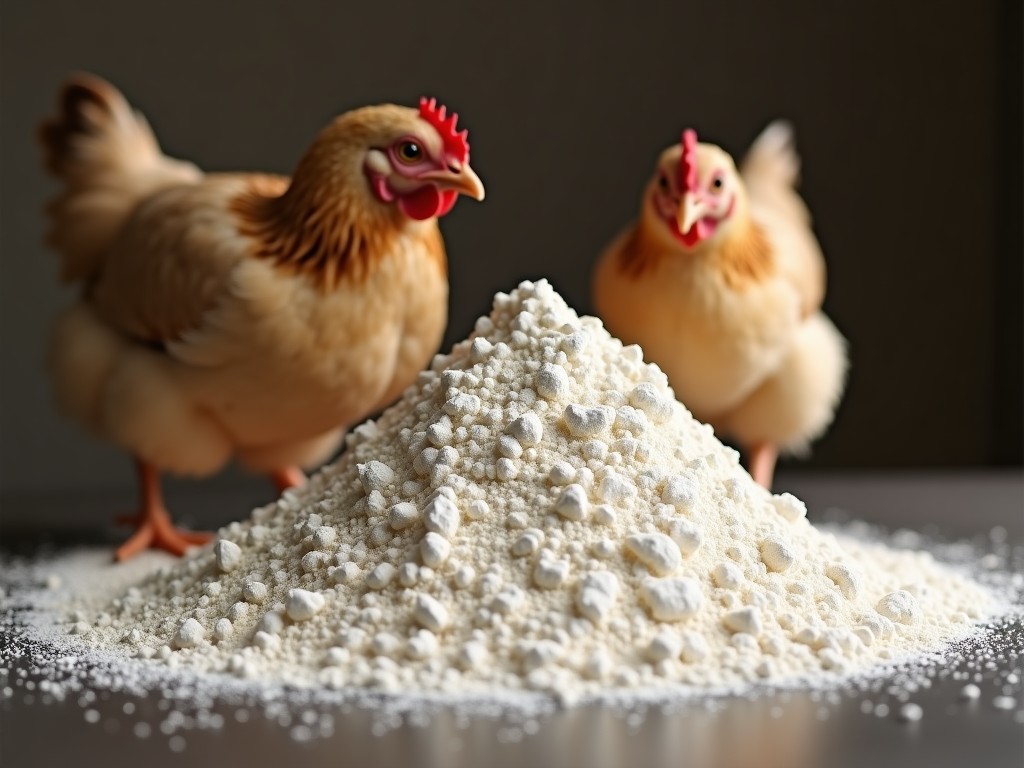
Diatomaceous Earth With Calcium Bentonite For Chickens
Diatomaceous Earth with Calcium Bentonite for Chickens
This feed additive combines the amorphous silica of diatomaceous earth with the swelling clay properties of calcium bentonite. The resulting mineral blend is designed to modify gut environment and litter moisture in poultry operations.
Composition and Mineralogy
The product consists of approximately 70 % fossilized diatom frustules (amorphous SiO₂) and 30 % calcium‑exchanged bentonite (mainly montmorillonite). The diatomaceous fraction provides a porous abrasive matrix, while the bentonite contributes cation exchange capacity and water‑holding ability.
Physical Properties
| Property | Typical Range | Test Method |
|---|---|---|
| Bulk density (loose) | 0.35 – 0.55 g/cm³ | ASTM C29 |
| Particle size (d50) | 15 – 35 µm | Laser diffraction |
| Moisture content | ≤ 8 % (w/w) | ASTM D2216 |
| pH (10 % slurry) | 7.5 – 9.0 | ISO 787-9 |
| Cation exchange capacity (CEC) | 70 – 100 meq/100 g | AMETEK method |
Functional Mechanism in Poultry Feed
When ingested, the sharp edges of diatomaceous fragments can disrupt the cuticle of external parasites and larvae in the gut lumen, providing a mechanical barrier. Simultaneously, calcium bentonite adsorbs ammonia and excess water, reducing litter pH and inhibiting pathogenic bacterial growth.
In trials, inclusion rates of 0.5 % to 2.0 % of total feed weight have shown measurable reductions in fecal moisture content (average 12 % decrease) and ammonia emissions (average 18 % decrease) compared to basal diets.
Handling, Storage, and Safety
The material is non‑flammable and chemically stable under normal feed processing temperatures (< 80 °C). It should be kept in a dry, well‑ventilated area to prevent clumping; moisture uptake above 10 % can reduce flowability.
Personal protective equipment recommended during bulk handling includes a dust mask (NIOSH N95 or equivalent) and safety goggles, as fine silica particles can irritate respiratory mucosa.
Quality Control and Testing
Each lot undergoes sieve analysis to verify particle size distribution, loss on drying for moisture, and titration for exchangeable calcium. Results are recorded against internal specifications before release.
- Particle size distribution (laser diffraction)
- Moisture content (loss on drying)
- pH of 10 % slurry
- Cation exchange capacity (ammonium acetate method)
- Heavy metal screening (Pb, Cd, As, Hg) – limits < 10 ppm each
Customization Options
The blend ratio, particle size cut‑off, and surface treatment can be adjusted to match specific feed mill equipment and flock requirements.
- Diatomaceous earth content: 50 % – 80 % by weight
- Calcium bentonite content: 20 % – 50 % by weight
- Target d50: 10 µm – 50 µm (adjustable via milling)
- Surface coating: optional food‑grade anti‑caking agent (silicon dioxide) up to 1 %
- Packaging: 25 kg multi‑wall paper bags, 500 kg FIBC, or bulk tanker
Frequently Asked Questions
Q: What inclusion rate is recommended for broiler feed?
A: Typical trials show optimal results at 1.0 % to 1.5 % of total feed weight, adjusted based on litter moisture targets and ambient humidity.
Q: Can the product be used in organic poultry programs?
A: Both diatomaceous earth and calcium bentonite are listed as permissible substances under many organic standards, but verification with the certifying body is required before use.
Q: How does the additive affect feed pellet durability?
A: At inclusion levels below 2 %, the blend typically does not impair pellet durability; higher levels may require a modest increase in conditioning temperature or binder dosage.
Get Technical Support
For formulation assistance, sample requests, or detailed spec sheets, contact our technical team.
Request Information