
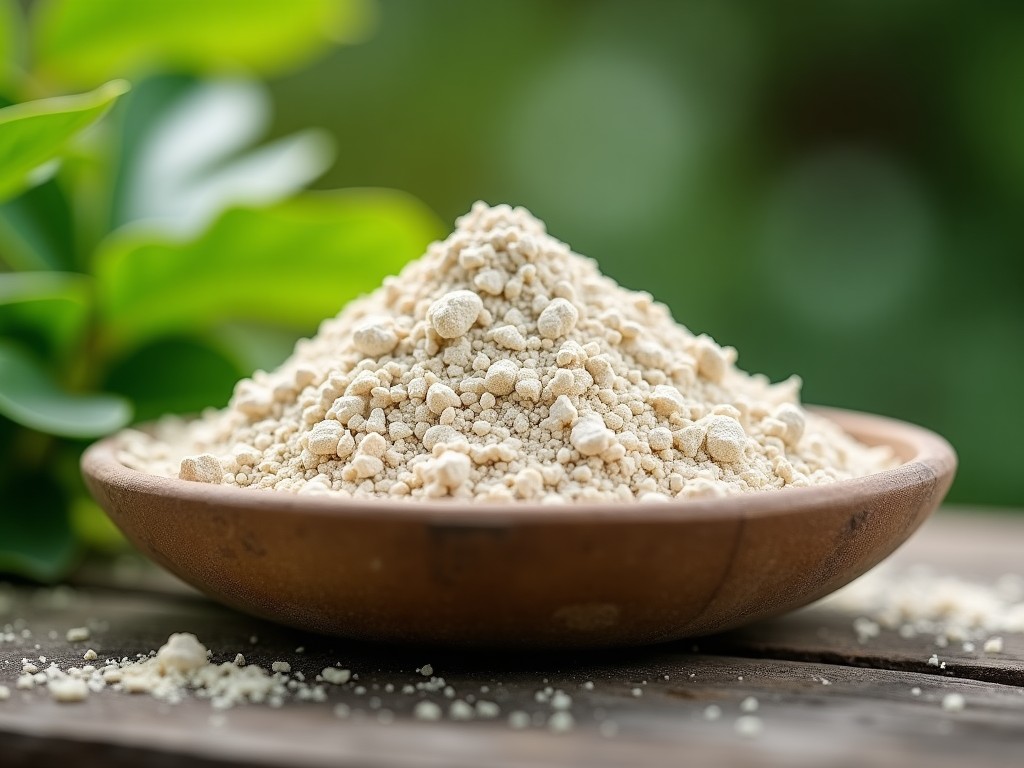
Diatomaceous Earth With Calcium Bentonite For Garden
Diatomaceous Earth with Calcium Bentonite for Garden Applications
Product Overview
This material combines natural diatomaceous earth (DE) with calcium bentonite clay to create a mineral amendment that modifies soil physical and chemical properties. The DE fraction consists of fossilized silica shells, while the calcium bentonite provides expandable silicate layers that contribute cation exchange capacity.
Composition and Structural Characteristics
Typical formulation contains 70–80 % diatomaceous earth and 20–30 % calcium bentonite by weight. The DE particles exhibit a porous microstructure with pore diameters ranging from 0.1 to 10 µm, contributing to high surface area. Calcium bentonite platelets have a layer thickness of about 1 nm and a swelling potential that increases interlayer spacing upon hydration.
Key Technical Properties
| Property | Typical Value | Test Method / Note |
|---|---|---|
| Bulk density (loose) | 0.30–0.45 g cm⁻³ | ASTM C29 |
| Particle size D50 | 15–25 µm | Laser diffraction |
| Moisture content (as‑received) | ≤5 % wt | Thermogravimetric analysis |
| pH (1 % slurry) | 7.5–8.5 | ASTM D4972 |
| Cation exchange capacity (CEC) | 70–90 meq 100 g⁻¹ | Ammonium acetate method |
| Silica (SiO₂) content (DE fraction) | ≈85 % wt | X‑ray fluorescence |
Values represent typical ranges for standard product grades; exact figures can be adjusted according to project‑specific ratios of DE to calcium bentonite.
Mechanism of Action in Garden Soils
The porous DE fraction improves water retention by holding moisture within its internal voids, while simultaneously enhancing drainage through inter‑particle voids that prevent waterlogging. Calcium bentonite contributes swelling capacity that increases soil aggregation, reducing bulk density and improving root penetration.
Cation exchange sites on the bentonite layers retain essential nutrients such as potassium, calcium, and magnesium, making them available for plant uptake over extended periods. The combined effect results in a medium with higher available water capacity and improved nutrient buffering.
Typical Garden Applications
- Soil amendment for vegetable beds – incorporated at 5–10 % wt to raise water holding capacity.
- Top‑dressing for lawns – applied at 2–4 mm thickness to improve surface moisture uniformity.
- Container mix component – blended with peat or coir at 10–15 % wt to reduce shrinkage and increase CEC.
- Seed‑starting medium – used as a sterile, inert base that supplies micronutrients from DE silica.
Handling, Storage, and Safety
The product is non‑hazardous under normal use; however, fine dust may cause respiratory irritation, so use of a dust mask is recommended during bulk handling. Store in a dry, covered area to prevent moisture uptake that could alter bulk density and flowability.
Shelf life is indefinite when kept sealed; no chemical degradation occurs under ambient temperature ranges (‑20 °C to 40 °C).
Packaging Options
- Multi‑wall paper bags with inner polyethylene liner – 25 kg net weight.
- Bulk flexible intermediate bulk containers (FIBC) – 500 kg or 1000 kg capacity.
- Retail‑size resealable pouches – 5 kg for garden centre distribution.
All packaging units are labeled with lot number, composition ratio, and recommended application rates.
Frequently Asked Questions
- Can the DE‑to‑bentonite ratio be customized? Yes, the ratio can be adjusted between 60/40 and 90/10 to target specific water retention or CEC requirements.
- What information is needed for a quotation? Required details include desired quantity, packaging type, target application rate, and any specific particle size or moisture content limits.
- How is product quality verified? Each batch undergoes routine testing for bulk density, particle size distribution, moisture content, pH, and CEC according to the methods listed in the technical table.
- Are there any restrictions on use in organic gardening? The material is composed of naturally occurring minerals and contains no synthetic additives; it complies with common organic input standards when sourced from approved deposits.
Contact for Technical Inquiry
To discuss formulation adjustments, request a sample, or obtain a detailed quotation, please reach out to our technical sales team.
Request Information